
UEA slip rings are often designed to include communication circuits such as Ethernet and CanBUS. Over the years, we have developed our own set of communication circuit standards for quality data transmission for our customers. While these are not the only communication circuits we can facilitate, they are the most common.
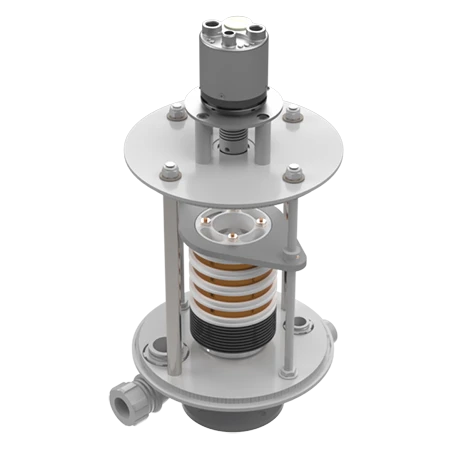
CanBUS Circuits
CanBUS circuits are communication circuits that use a twisted pair of CAN-High and CAN-Low wires. Depending on the application, these twisted pairs can either be shielded or unshielded. Typically shielding is only required if there are high power circuits within the same slip ring, but shielding is always recommended for the most reliable data transmission. The standard cable type used for this application is J1939, and the wire gauge is typically 18 to 20 AWG. When UEA receives a request to implement CAN circuits within our design, we always ensure the following:
- The rings used in our core assembly are silver plated or coin silver.
- The brush assemblies are silver graphite.
- Silver is an excellent conductor that ensures high quality data transmission. It also helps with corrosion resistance on the rings.
- Wire leads soldered to the rings within the core assembly are shielded 18/1 cables.
- Shielding internal to the core can be completed for additional signal isolation.
- The cables used in our harnesses are J1939 unless another cable is specified by the customer.
Ethernet Circuits
Ethernet circuits are communication circuits that use multiple twisted pairs with a shield. The typical Ethernet setup at UEA is 5-circuit or 9-circuit. On our standard 1.50” bore or smaller designs, 5-circuit Ethernet (2 twisted pairs & shield) is rated up to 100mbps max, while 9-circuit Ethernet (4 twisted pairs & shield) is rated up to 1gbps max. Additional brush technologies like wire brush have been used with successful testing up to 5gbps. Bore size is also limiting factor on the data rate. Using the 9-circuit Ethernet setup on our 2.50” – 4.00” bore series results in lower overall data rates. This series commonly has a max data rate of 100mbps. On anything above the 4.00” bore size the max data rate is 10mbps due to the larger ring material required to complete the assembly.
There are many different cable types and connectors for Ethernet circuits. These also greatly affect the data rates. Standard Ethernet cable types are CAT cables. CAT cable rating and specifications are controlled and at UEA we typically use Cat5e (1gbps, 10MHz) or Cat6 (1gbps, 250 MHz). The common connectors at UEA include RJ45 (8P8C, TIA-568B) and M12 (A, D, or X code) connectors. Additional connectors can be reviewed based on customer requirements.
When UEA receives a request to implement Ethernet circuits within a design, we ensure the following in the design review:
- The rings used in our core assembly are silver plated or coin silver.
- The brush assemblies are silver graphite.
- Silver is an excellent conductor that ensures high quality data transmission. It also helps with corrosion resistance on the rings.
- XLP or GPT wire leads soldered to the rings are twisted within the core assembly (1 twist per inch minimum, 2 twists maximum).
- Circuits are stacked in a way that keeps brush assemblies from the same twisted pair on the same side.
- This allows us to keep the brush harness wires twisted as close as possible to our brush assembly terminations.
- If the requirement is 1gbps, the core leads are soldered directly to the center harness leads instead of using crimp connectors. Solder joints are then covered with heat shrink and the pairs are retwisted. The shield core lead is butt spliced to the shield of the Cat cable and left exposed. The entire 9-wire bundle is then covered with a tubular braid shield that contacts the uninsulated butt splice. Finally, the tubular braid shield is covered with dual wall heat shrink.
- This method of connection allows for a seamless transition between the rings and the center leads.
- Every slip ring with Ethernet circuits is tested using a BERT (Bit Error Rate Test) tester to verify that the slip ring meets the data rate required by the customer.