
Space is having a moment. Companies like SpaceX, Blue Origin, and Rocket Lab are launching more rockets than ever before, and the numbers are hard to ignore. The industry is on track for over 250 orbital launches in 2026 alone, and the commercial satellite market is projected to more than triple in size by 2034. That’s a massive wave of hardware heading into orbit, and every single piece of it has to work perfectly once it gets there.
But here’s something most people never stop to think about, before a satellite can do anything useful, it needs to solve a surprisingly simple mechanical problem. Parts of it need to spin.
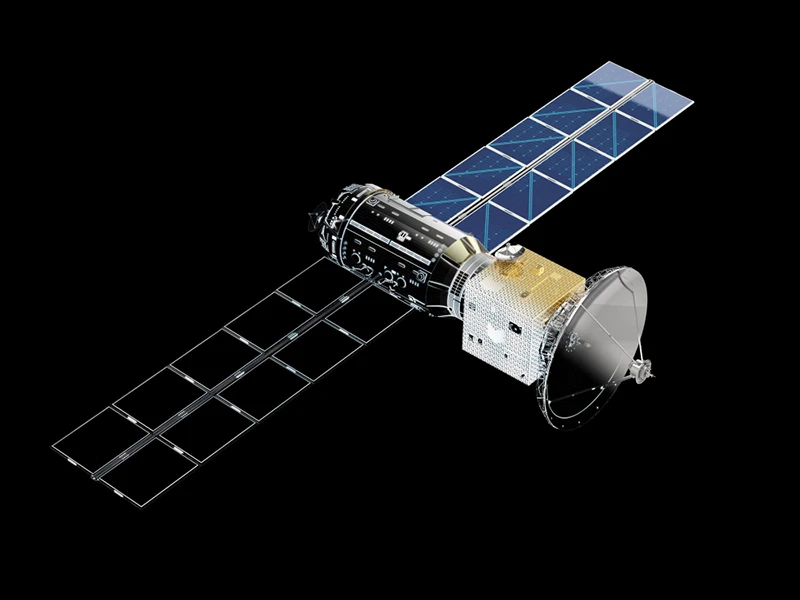
Think about how a satellite retains its power. It uses solar panels, big wing-like arrays that unfold after launch and catch sunlight to generate electricity. The thing is, a satellite is constantly moving through space, orbiting the Earth every 90 minutes or so. To keep getting power, those solar panels need to track the sun as the satellite moves. That means they’re rotating constantly, like a sunflower turning its face toward the light. The body of the satellite, meanwhile, stays pointed at Earth.
So, you’ve got one part spinning and another part staying still. Now try to run electricity between them. If you just ran wires straight through, they’d twist up and snap in a matter of hours. That’s where a slip ring comes in.
A slip ring transfers electrical power, signals, and data between a part that’s rotating and a part that isn’t. It’s the reason a spinning solar panel can keep feeding power to the rest of the satellite without the wires getting tangled into a mess. Not the most glamorous technology in the world, but without it, the satellite stops working the moment the panels start to move.
The same idea applies to antennas. A satellite antenna has to rotate freely to stay pointed at a ground station back on Earth. A communication satellite that can’t aim its antenna is about as useful as a cell tower with no power. Slip rings keep that connection alive no matter which direction the antenna needs to face. GPS satellites, weather satellites, Earth imaging systems, and broadband constellations like Starlink. All of them have rotating components, and all of those components need a continuous, unbroken electrical path to do their job.
What makes space-grade slip rings so different from the ones used in a factory or on a farm is what they have to survive. There’s no technician floating around up there to swap one out if it fails. It has to work from the moment of launch through the end of the satellite service life, which can stretch more than a decade. That means handling the vacuum of space, temperature swings of several hundred degrees, constant radiation exposure, and the violent shaking of a rocket launch, all without missing a beat.
Standard industrial materials won’t cut it in that environment. Space-qualified slip rings use specialized composite materials, gold-plated contacts, and lubricants designed specifically for a vacuum. Every one of them is engineered for the specific mission it’s going on. The tolerances involved reflect years of hard-won engineering experience.
That’s where UEA comes in. We’ve been building slip rings since the 1960’s, which means we were solving rotating electrical connection problems long before most of today’s private space companies even existed. Over the decades, we’ve developed the kind of application engineering experience that only comes from working across a wide range of industries and some genuinely tough operating conditions. Agriculture, oil and gas, wind energy, military and defense. If a slip ring has to perform with no room for failure, chances are we’ve built something like it.
What that means for space applications is that we’re not starting from scratch. When a design engineer comes to us with a specification that calls for compact size, high reliability, and the ability to handle power and signals simultaneously, that’s a conversation we’ve had before. We can work with customers early in the design process to figure out what the application actually needs, rather than just dropping a catalog part into a drawing and hoping it holds up.
Engineers working on satellite systems, ground support equipment, launch vehicle mechanisms, and test hardware all need slip ring solutions they can count on. UEA has the experience, the manufacturing capability, and the ISO 9001:2015 certification to be that supplier.
The commercial space industry gets a lot of attention for its rockets and its billionaires and the big-picture vision of humanity becoming a multi-planet species. That’s all exciting stuff. But the satellites that are actually changing everyday life right now, the ones delivering internet to remote farms, tracking severe weather, guiding cargo ships across the ocean, and keeping GPS accurate to within a few feet, those satellites all depend on components most people have never heard of.
Slip rings aren’t the flashiest part of the story. They’re just the part that makes the whole thing work. And building things that work, no matter where they end up, is what UEA has been doing since 1952.