
More equipment is becoming connected across fleets and facilities, the requirement for reliable data communication signals continues to grow. In many systems, transmitting both data and power through a single slip ring is necessary, but doing so requires careful design to maintain signal quality.
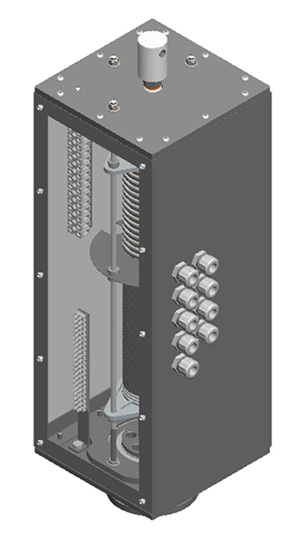
Separating Data and Power Is Important.
For accurate data transmission, it’s notable to isolate communication signals from power circuits. This separation minimizes electrical interference that can degrade signal integrity. Achieving this requires proper shielding, both in the cable assemblies and within the slip ring itself.
Cable Shielding for Signal Protection
Cable shielding maintains clean communication signals. Shielded cables, such as CAT-rated Ethernet, shielded CANbus, and shielded VFD cables help protect sensitive signals from power-related noise. The appropriate shielding type depends on the specific application and the nature of the circuits involved.
Internal Slip Ring Design Considerations
Inside the slip ring, various designs are used to separate data and power paths. These may include:
- Dedicated shield circuits
Cable shields are soldered to dedicated shield circuits, creating a larger gap between power and signal circuits within the core. This also allows shielding continuity through harnesses on both sides of rotation. - Multiple slip ring cores
Physically separating power and signal cores is often the best option when the cores share the same bore size and there are no height restrictions on the overall unit. - RFI (Radio Frequency Interference) barriers or enclosures
These provide additional protection by blocking both external interference and internal interference from the power core. - Separate slip rings for data and power
In some cases, UEA has designed entirely separate slip rings for power and communication circuits that piggyback off one another. This approach is ideal when large-amperage power circuits require a larger bore, while high-data-rate circuits benefit from a smaller bore.
Some custom applications require a combination of these techniques to meet performance requirements. For example, UEA has developed many dual-core slip rings that physically separate power and data paths. An RFI plate can be positioned between the cores to further reduce interference. Shielded cables are used throughout, with additional shield circuits providing extra protection for sensitive data signals.
Tailored Solutions for Complex Requirements
At UEA, we specialize in designing custom slip rings that transmit both power and data while preserving the integrity of each. Depending on the system’s power levels and the type of data signals, our engineers may implement multiple separation and shielding strategies to ensure optimal performance.
By integrating these techniques, custom slip rings can deliver both reliable power and high-quality data transmission.