
Military vehicles rely on electrical systems for communication, cameras, sensors, targeting equipment, radar, controls, and other onboard equipment. When these systems are mounted on a turret or another rotating part of the vehicle, power and data still need to move between the stationary and rotating sections. A slip ring provides this connection while allowing continuous rotation without twisting cables.
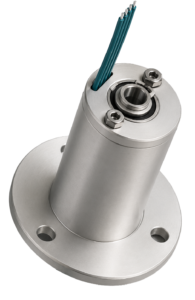
A slip ring transfers power, signals, and data across a rotating connection. In an armored vehicle, the stationary side can connect to the vehicle’s electrical system while the rotating side connects to equipment mounted on the turret. Depending on the application, a single slip ring can carry power, Ethernet, CAN, HD video, control signals, and other mixed signals.
UEA slip rings can be designed with anywhere from one to more than 100 circuits, with standard current ratings up to 600 amps and standard voltage ratings up to 600 volts. Custom designs with ratings above 1,000 amps and 1,000 volts are also available for applications that require more power.
Running cables directly between a vehicle and rotating turret can cause them to twist or bend as the turret moves. This can restrict movement and add wear to cables and connections over time. A slip ring allows the turret to rotate continuously while keeping electrical and communication systems connected.
For systems that need to move large amounts of data, UEA can also incorporate high-speed Ethernet. This can support cameras, radar, sensors, surveillance equipment, and other systems that rely on a steady flow of data during rotation.
There is no single slip ring design that works for every military vehicle. Available space, mounting, circuit count, power, data, rotational speed, and operating conditions can all change from one application to another. UEA offers through-bore, compact, and custom designs that can be built around the vehicle rather than forcing the vehicle to work around the slip ring.
Sealing can also be added for protection from dust, spray, or washdown. Designs can account for shock, vibration, temperature changes, and other conditions commonly found in military ground vehicle applications.
The same approach can be used across a range of defense equipment. UEA slip rings can be designed for armored vehicles, remote weapon stations, radar systems, EO/IR platforms, communications equipment, unmanned systems, naval equipment, and other applications where power, signals, or high-speed data need to cross a rotating connection.