
United Equipment Accessories (UEA) has introduced a new load-bearing slip ring capability for applications where the rotating connection needs to handle more than power, signals, and data. These custom assemblies combine electrical transmission with mechanical support, allowing the slip ring to help carry axial, radial, and moment loads. This gives engineers another option for equipment where structural support and electrical connections need to come together at the same point of rotation. Rather than treating the slip ring as a separate electrical component, UEA can design it to become part of the equipment’s structure.
Designing Around the Load
Most slip rings are selected based on electrical requirements such as circuit count, voltage, current, data, and rotational speed. With a load-bearing slip ring, the mechanical requirements become an important part of the design as well. Engineers look at how the equipment is mounted, where forces enter the assembly, and what the slip ring will experience during operation. This can include axial and radial loads, moment loads, shock, vibration, and the weight of suspended equipment. The housing, base plate, cover, bearing arrangement, and mounting features can then work together to help distribute those forces throughout the assembly rather than placing most of the load on the bearing. This can reduce concentrated bearing loads, improve stiffness, and help keep internal electrical components properly aligned during operation.
Built Into the Equipment
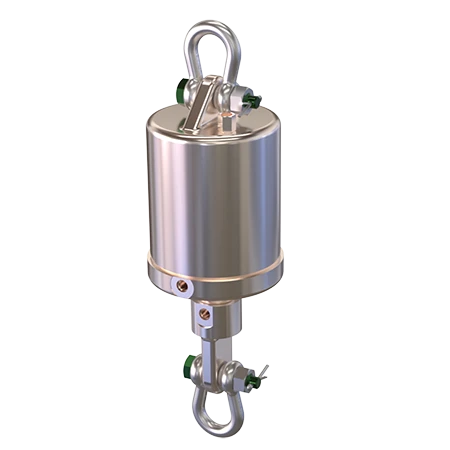
Because each application is different, the mechanical interface can be designed around the customer’s equipment. Custom bolt patterns, flanges, lifting points, shackle connections, locating features, and mounting fixtures can be incorporated directly into the slip ring. Building these features into the assembly can reduce the need for additional brackets, adapter plates, or modifications during installation.
The electrical side is just as flexible. Power and signal circuits can be combined with high-speed data, and other rotary components such as encoders, hydraulic rotary unions, fiber optic rotary joints, and RF rotary joints can be incorporated when needed. The result is one assembly designed around the complete rotating interface.
A Different Approach to the Rotating Interface
Load-bearing slip rings can be a good fit for rotating platforms, marine equipment, autonomous systems, lifting equipment, defense applications, heavy industrial machinery, and other equipment where mechanical and electrical requirements meet at the same rotating connection. Instead of designing the structure first and then finding a place for the slip ring, UEA can look at the rotating interface as a whole.
By considering the mechanical loads, electrical requirements, mounting needs, available space, and operating conditions together, UEA can develop a load-bearing slip ring that fits the way the equipment actually needs to work.